Sentence Mining: How to Do It Correctly With Anki or Any SRS (2026 Guide)
Sentence mining means collecting real example sentences from things you already watch or read, then reviewing them in a spaced repetition system. Instead of memorizing isolated words from a list, you learn from lines you actually heard in context. This guide walks through how to choose sentences, build cards that work, and keep the whole process manageable.
What is Sentence Mining?
Sentence mining is a different way to learn vocabulary. Instead of memorizing isolated words from a frequency deck, you learn them through real sentences. So instead of learning the word for "courage" from a spreadsheet, you learn it from the exact moment a character in your favorite show says it. You are not just memorizing a definition. You are remembering a scene.
How it works
- You take the whole sentence from whatever you're watching, not just a single word.
- The sentence gives you context, which makes the word easier to remember.
- You get to choose exactly what you want to learn based on what you enjoy watching.
Sentence Mining vs Traditional Vocab Study
- Vocabulary in context vs. flashcards of isolated words
- Audio/visual memory hooks (the scene, the voice)
- i+1 principle: sentences just above your current level (Krashen, 1985)
- Motivation: learning from content you actually enjoy
Why It Works
Most people remember stories and scenes better than raw data. When you mine a sentence, the new word gets tied to something you already remember: the scene, the character's face, or the sound of their voice. That is what helps it stick.
Why Context Helps Memory
- Episodic memory: words tied to scenes are recalled faster
- Dual coding: text + audio reinforces retention
- Emotional engagement: interesting content = stronger memory traces
What Makes a Good Sentence Card
| Card Element | What to Include | What to Avoid |
|---|---|---|
| Sentence | One mostly understood line with one new idea | Dense lines with multiple unknowns |
| Audio | Exact subtitle-aligned clip | Whole-scene audio with long silence |
| Meaning | One target meaning or short gloss | Paragraph-length translations |
| Context | Optional screenshot or scene memory | Extra notes you will never review |
The best cards are easy to review and easy to understand. If a card takes too long to parse, the sentence is usually too advanced or the back side has too much going on.
Sentence Mining vs. Vocabulary Lists
| Method | Strength | Weakness |
|---|---|---|
| Sentence mining | Builds recall from real context, sound, and collocation | Requires better source selection |
| Word lists | Fast for covering basic high-frequency vocabulary | Weak transfer to listening and natural phrasing |
| Hybrid approach | Lets you learn basics fast, then shift into context | Needs discipline to avoid bloated decks |
If you are still building a core vocabulary, isolated cards can help early on. But once you want better retention, faster listening, and more natural phrasing, sentence cards usually work better because each review gives you a real chunk of language instead of a detached definition.
When Should You Start?
You do not need to wait until you are advanced, but complete beginners usually need a small base first. If every line has five unknown words, sentence mining quickly turns into a pile of cards you cannot really learn from. The sweet spot is when you can follow the general meaning of easy content and most lines contain only one new thing worth learning.
- Too early: you cannot follow simple learner content without constant lookups.
- Good time to start: you understand the scene, but one word or one structure stands out as new.
- Best early sources: slow dialogue, learner podcasts, slice-of-life shows, simple interviews.
What Should You Mine?
During a normal immersion session, you will see far more unknown words than you should turn into cards. You are not trying to capture everything. You are trying to pick the ones that are most worth reviewing.
A useful rule is simple: if a word or phrase will probably stick without SRS support, skip it. Save your cards for things that really need repetition. That keeps your daily reviews focused on the vocabulary that would otherwise keep slipping away.
1. Start with Familiar Words
If a word keeps showing up across episodes, articles, or conversations, that is usually a good sign it belongs in your deck. Familiar words are often frequent words, and those are usually the best ones to learn first.
2. Choose Words You Can Grasp
If the definition still feels abstract after you look it up, skip it for now. Sentence mining works best when the target item is already within reach and the sentence gives you enough context to make the meaning feel clear.
3. Choose Words You Care About
Interest matters. Words tied to scenes, topics, or situations you care about are easier to remember because they already mean something to you.
Choose the Right Content
Comprehensible input is still the basic filter here. The best source material is slightly above your level. You can follow the general message, but a few useful words or structures still stand out. If you want the full theory behind that, read our guide to comprehensible input.
- For listening: choose subtitle-supported shows, podcasts, interviews, or YouTube with clear dialogue.
- For reading: use articles, graded readers, transcripts, or forum posts you can mostly follow.
- Avoid content that is so dense you have to stop every few seconds.
The "One New Word" Rule
A lot of people follow what is often called the i+1 principle, drawn from Krashen's Input Hypothesis (1985). In practice, it means you should mine sentences where you understand everything except one new word.
- If there are too many unknown words, the sentence won't have enough context to help you remember the meaning.
- It's usually best to aim for a scene where you understand about 90% of what's happening.
Look for the Right Sentences
Not every unknown word deserves a card. Good mining targets show up repeatedly, matter to the kind of media you actually consume, and teach you something useful beyond a one-off definition.
- Mine words you have seen more than once or expect to see again soon.
- Prefer phrases, collocations, and grammar patterns that improve real comprehension.
- Skip obscure terms that only make sense in one scene unless they are directly relevant to your goals.
As a general rule, mine sentences rather than isolated words. A sentence gives you the meaning, grammar, tone, and typical usage all at once. It also keeps each card focused on one clear usage instead of making you juggle every possible meaning of a word at the same time.
How to Make Sentence Cards
The simplest useful card has the target-language sentence on the front and one short meaning on the back. If you are working with spoken content, add audio. If a screenshot helps you instantly remember the scene, add that too. Everything else is optional.
Anki is the most common choice because it gives you a lot of control over templates, scheduling, and add-ons, but it is not the only option. Other SRS platforms can work too, as long as they let you review sentence cards consistently without too much friction.
If you want concrete card formats, the exact setup changes a bit by language. See our guides to Japanese Anki flashcards, Spanish Anki flashcards, and Korean Anki flashcards for language-specific examples.
| Card Side | Recommended Content | Why |
|---|---|---|
| Front | Full target-language sentence | Tests recognition in context |
| Back | Short meaning or gloss | Confirms the target without overload |
| Optional | Audio clip or screenshot | Strengthens memory through sound and scene recall |
Keep the card focused on comprehension, not production. You are not trying to output a perfect translation from memory. You are checking whether you can understand the sentence and recognize the target item quickly.
What This Looks Like
Imagine you are watching a show and hear a line you mostly understand except for one phrase. That is exactly the kind of moment worth mining.
| Step | Example |
|---|---|
| Source line | I need to wrap up this project by Friday. |
| Target item | wrap up |
| Front of card | I need to wrap up this project by Friday. |
| Back of card | wrap up = finish or complete; add audio if available |
| Why it works | You remember meaning, tone, and typical usage together |
This is the real advantage over isolated vocab lists. You are not just memorizing a definition. You are learning how the phrase sounds, what kind of object follows it, and the sort of situation where people actually use it.
When to Make the Card
There are two good ways to handle card creation. In synchronous mining, you pause and make the card right away while you are watching or reading. In asynchronous mining, you save the sentence or timestamp first and build the cards later in a batch.
| Approach | Best For | Tradeoff |
|---|---|---|
| Synchronous | Learners who want one unified immersion-plus-mining session | More interruptions while consuming content |
| Asynchronous | Learners who want smoother immersion and bulk card creation later | Requires a second pass through saved sentences |
Neither approach is automatically better. If stopping every few minutes ruins your immersion, switch to asynchronous mining. If saving timestamps feels annoying, create the card on the spot and move on.
What Tools Can You Use?
The main difference between sentence mining setups is not which SRS platform you pick. It is how much friction there is between finding a useful line and turning it into a card. That usually decides whether the method still feels sustainable after the first week.
If you are specifically comparing local-file workflows against browser-first tools, our SubSmith vs Language Reactor comparison breaks down where each approach fits.
| Tool Type | Best For | Main Tradeoff |
|---|---|---|
| Manual SRS workflow | Maximum control and no extra software | Slowest setup and most friction |
| Browser extensions | Quick capture from supported sites | Weak local-file support and platform restrictions |
| SubSmith desktop workflow | Local video, subtitle generation, audio slicing, and SRS export | Best fit when you learn from downloaded media or offline files |
Anki is still the review engine many serious learners use because it gives full control over card templates and scheduling, but the broader rule is simple: use the SRS you will actually keep up with. The real difference is how fast you can capture cards from the content you are already consuming.
Why Manual Mining Gets Old Fast
Before dedicated tools like SubSmith existed, mining from spoken content often meant bouncing between your video player, recording software, and Anki. That is where many learners lose momentum. The method works, but the workflow becomes too tedious to keep up.
- Pause video at the right moment
- Switch to recording or note-taking software
- Record or clip the sentence manually
- Trim silence and export
- Paste text, attach audio, and organize the note
Manual card creation repeats several steps for every sentence, so the time adds up as the collection grows. That is why workflow friction matters alongside card quality.
How SubSmith Automates Sentence Mining
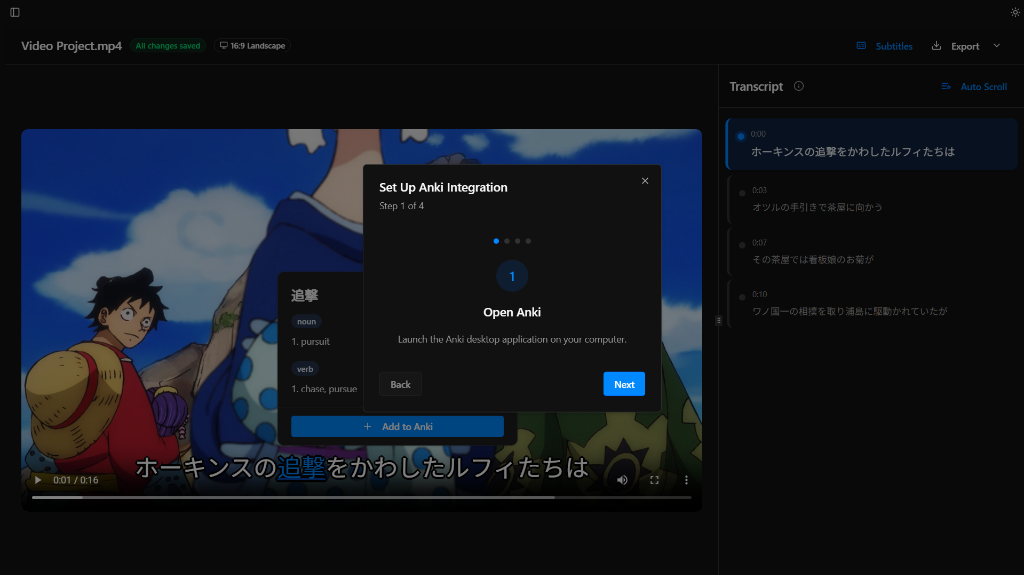
SubSmith handles the audio slicing, transcription, and dictionary lookups in one place. That turns a 3-minute manual process into something much faster.
The One-Click Workflow
- Any video or audio file (MKV, MP4, MP3)
- Whisper AI generates timestamped subtitles
- Select subtitle line → word lookup + audio slice
- One click via AnkiConnect
If this is your first time using Anki with SubSmith, you'll just need to install the AnkiConnect add-on. We have a quick AnkiConnect setup guide that covers it in about a minute, and a separate explainer on how one-click audio slicing works if you want to understand the workflow in more detail.
Time Comparison
| Method | Time per Card | 20 Cards |
|---|---|---|
| Manual recording | Varies by clipping, lookup, and field entry | Repeats every step for every card |
| SubSmith local-file workflow | Varies by transcript and card edits | Reuses timestamps and saved Anki mappings |
Why Desktop Beats Browser Extensions
- Direct file access (no streaming restrictions)
- FFmpeg slicing (instant, not real-time recording)
- Works offline (no internet required)
- No platform DRM blocking audio extraction
The Sentence Mining Process Step by Step
- Watch or read content you can mostly understand.
- Pause only when a sentence contains one useful unknown word or structure.
- Capture the full sentence, not just the isolated word.
- Attach the exact audio clip if it came from spoken content.
- Add one short meaning or gloss on the back of the card.
- Return to immersion quickly instead of polishing the card for minutes.
Whether you do this manually or with automation, the rule is the same: keep the capture step fast enough that it does not break the immersion session. If every card turns into a mini-project, the method stops being sustainable.
If your main target language is Japanese, the same workflow has a few extra considerations around subtitle sources, sentence density, and JLPT-level difficulty. Our Japanese sentence mining guide covers those separately.
How Many Sentences Per Day?
Do not try to mine every unknown word. Spend most of your time actually watching or reading, and only some of it mining. The goal is to stay in the content, not pause it every few seconds.
Daily Limits
- 5-10 sentences per episode maximum
- Quality over quantity (memorable scenes only)
- Skip sentences you half-understand (wait for clearer examples)
Review Strategy
- Review new cards same day (memory fresh)
- Start with 5-10 new cards/day max
- Scale up only when reviews stabilize
How to Review Sentence Mining Cards
Reviews should be fast. Look at the sentence, recall the target meaning or phrasing, flip the card, and grade it. If one card keeps taking more than 5 to 10 seconds, it is usually too dense or poorly designed.
- Review once per day whenever possible.
- Review new cards the same day you mined them.
- Keep new cards low enough that daily reviews stay manageable.
- Do not re-study every card during review. Recognition and recall are the point.
Milestone Targets
| Cards Mined | Expected Outcome |
|---|---|
| 100 | Process feels natural |
| 500 | Noticeable comprehension improvement |
| 2,000 | Intermediate plateau breaking |
| 5,000+ | Advanced comprehension |
If you want the longer-term version of this idea, read our guide to the 10,000 sentence method. It explains how sentence mining can grow from a daily habit into a broader fluency strategy.
Common Mistakes
- Mining too many cards per day before your reviews stabilize
- Choosing sentences with multiple unknowns instead of one clear target
- Turning the back of the card into a grammar essay
- Mining from content that is far above your level
- Spending more time editing cards than actually immersing
Most people do not fail because sentence mining does not work. They fail because the workflow is too slow, the cards are weak, or the daily reviews get out of hand. Fix those three things and the method becomes much easier to keep up.
FAQ
- Does sentence mining actually work? Yes. It works because you learn words in context instead of in isolation. Words tied to memorable scenes usually stick better. The hard part is not the method. It is keeping the workflow sustainable.
- What is the 10000 sentence method? It is the idea that reviewing thousands of real sentences can build strong comprehension over time. The number is more of a long-term benchmark than a magic cutoff.
- What is the "one word" rule? It means you should mine sentences where you understand everything except one word. If a sentence has too many unknowns, there usually is not enough context to make the card useful yet.
- Is sentence mining worth it? For a lot of learners, yes. It is especially useful once you are past the beginner stage and want to get better at real phrasing, listening, and collocations instead of just memorizing definitions on their own.
- How long does it take to mine 1,000 cards? It depends on your workflow. With manual tools, it can take dozens of hours. With automation, it gets much faster. The exact number matters less than whether your process is quick enough to keep doing consistently.
- What if I don't have subtitles? You can still do it. If your tool can generate subtitles from audio, you can mine from podcasts, raw video, or other files that do not already have subtitle tracks.